History
- An Outline
- Maps
- A Yates County Gallery
««Milo Center
««The Road past Tom Lee's
««Penn Yan
««Jackson Street
PLACES: Tom Lee's Highway
The road leading past Thomas Lee's house to David Wagener's Mill in Penn Yan is mentioned in a survey of November 1800, when a new road is described as intersecting it. Interestingly, Lee isn't mentioned in this survey by name, where the road is merely described as running from "Waggoners Mills" past the residences of Susannah Clamford and John Lawrence.The first mention of Thomas Lee's place in the early town of Milo road surveys is in 1806, when a road intersects another "leading from Thomas Lees to Waggoners Mills near the Widow Clamfords." This is the road, now Yates County Rte 1, the Himrod Road as an extension of East Main Street, that Joshua Lee remembered helping as a boy to chop through the woods. All early roads in the area were laid out and constructed in this way, by local freeholders who were assessed so many days of labor on the roads each year based on how much property they owned. Once the surveys were officially entered in the town's records, the roads so built became the property and responsibility of the municipality.
This is certainly one of the County's earliest roads, leading as it did from the neighborhood of Richard Smith's mill at the falls of Keuka Lake Outlet, where a bridge carried the highway between Geneva and Bath across the stream, to a crossroads hamlet three miles upstream, the as yet unnamed Penn Yan and David Wagener's gristmill.
All the people mentioned in the survey are well-known early settlers of Milo, originally drawn here by the teachings of the Public Universal Friend, though none were official followers of hers. John Lawrence was from New Bedford, Massachusetts, a Revolutionary veteran and a prosperous Quaker shipbuilder. He built an early store and by 1800 had a gristmill of his own, also on the Outlet (a perennial stream with the lake as an inexhaustible reservoir, with a drop over its 6-mile length of more than 270 feet).
David Wagener was a native of Montgomery County, Pennsylvania. He built the first public house in our county in 1791, near the falls of the Outlet, a place mentioned by the Duke deLiancourt in the memoir of his 1793 travels on the New York frontier; in 1794 Wagener bought a sawmill at the site of modern Penn Yan and in 1796 built a gristmill on the Outlet's south bank. He arranged for what is now Main Street to be surveyed through the woods to his mill, recruited a physician and other settlers, and made sure his many daughters married well. The estate inherited in 1799 by his two sons comprised much of the future village's industrial and commercial areas, and the elder son, Abraham, was the first postmaster and later first mayor of Penn Yan.
Susannah "Clamford" was David Wagener's sister. Her first marriage was to Peter Supplee, and her second to John Clumberge, a man whose surname was impervious to all future generations' attempts to spell it. Widowed twice, she had a place of her own along the highway where she lived out the rest of her life. She is buried near her brother, whose burial in 1799 was the first in what is now Lakeview Cemetery, owned by the village of Penn Yan and added this year to the National Register of Historic Places.
Thomas Lee was one of dozens of veterans of the Revolution who came to this county after the war and the subsequent settlement of the Senecas' claim to the land. His father Nathaniel Lee was a native of Ireland who settled near Fishkill, married and died there in 1793, aged 98. Thomas was his eldest son, born in 1739. He came to what was then called Jerusalem in 1790, and died there in 1814, at the age of 75.
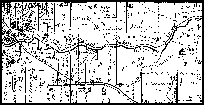
Click on this map for a larger map and text on the residents along Tom Lee's highway.